
Published: · Last Reviewed: · Author:
Related to Mutual Funds
Disclosure. Educational content only. This article provides educational information about Bitcoin and macroeconomic trends. It is not financial advice. Bitcoin is a highly volatile, speculative asset. You could lose your entire investment. I am a licensed Financial Security Advisor and Mutual Fund Representative. Mutual funds through WhiteHaven Securities Inc. Insurance through iAssure Inc. See Disclaimer and Privacy.

Bitcoin for Business Owners

Visual Overview Full Analysis →

Bitcoin in 2026: A Visual Guide

Scannable overview of the crash, macro context, bull case, bear case, and what to watch.

Why This Matters Now

  • Bitcoin crashed over 50% from its October 2025 peak of $126,000
  • Multiple bearish forces could drive it lower ($40k-$50k scenarios)
  • Six macroeconomic forces continue pressuring the US and Canadian dollar
  • Gold closed 2025 above $4,300, up over 140% since early 2023
  • Understanding both opportunities and risks matters

Request a structure review to discuss how this affects your situation.


The Current Situation

-52%

Bitcoin crash from peak

$126,000 (Oct 2025) to $60,000 (Feb 5, 2026)

$70,000

Current Bitcoin price

Still 45% below all-time high

$4,300+

Gold price end of 2025

Up over 140% since early 2023. Only -15% from peak vs Bitcoin -52%
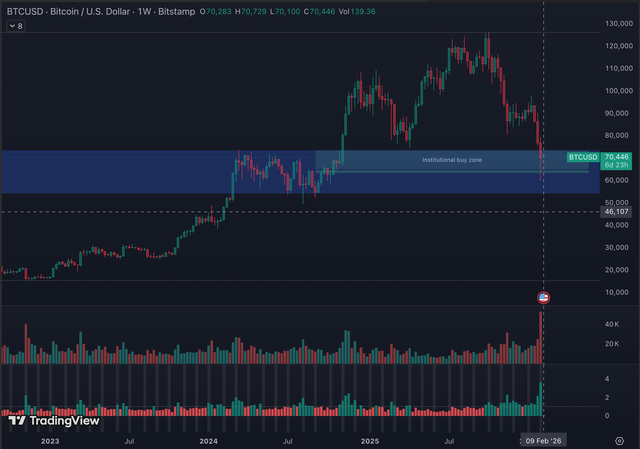
Bitcoin price chart: Weekly candlesticks from early 2023 to February 2026 showing bull run to $126,000 peak, sharp correction to $60,000, institutional buy zone $60k-$75k, and current price near $70,000.
Chart as of February 9, 2026. Bitcoin weekly price action: peak October 2025, correction, institutional buy zone ($60k-$75k). Source: TradingView (Bitstamp data).

The Context: Six Converging Forces

Before examining Bitcoin itself, understand the six forces creating pressure on fiat currencies. For full detail, see our inflation and dollar devaluation analysis.

1

Quantitative Easing: Money Creation Restarted

December 2025: The Fed resumed Treasury purchases at ~$40B/month. When money supply grows faster than output, purchasing power typically declines.

Impact: Dollar weakens | Inflation increases

2

US Debt: $38 Trillion and Growing

$6-9T maturing in 2026. ~$1T annual interest. The government issues new debt to refinance. More debt, more Fed support, more money creation.

Impact: Dollar weakens | Inflation increases

3

Central Banks: Selling Treasuries, Buying Gold

Gold: $1,800 (early 2023) to $4,300+ (late 2025). Central banks bought 1,000+ tonnes for three consecutive years. Signals declining confidence in reserve currencies.

Impact: Dollar weakens | Confirms devaluation

4

Yen Carry Trade: Massive Unwinding

Estimated $1-4T. Investors borrowed cheap yen to buy dollar assets. Bank of Japan raised rates. Now unwinding: selling dollar assets to repay yen loans.

Impact: Dollar weakens | Adds volatility

5

Policy Direction: Weaker Dollar May Be Intentional

A weaker dollar boosts exports and reduces the real value of $38T debt. If the dollar loses 30%, real debt burden drops ~$11T. Some analysts see this as deliberate.

Impact: Dollar weakens | Inflation increases

6

The US-Canada Connection

75% of Canadian exports go to the US. When the US dollar weakens, the Canadian dollar typically weakens too. Canadian business owners cannot ignore US monetary policy.

Impact: CAD weakens with USD | Inflation affects Canada


All Arrows Point the Same Direction

ForceDollar ImpactInflation Impact
QE restartingWeakensIncreases
$38T debt growingWeakensIncreases
Central banks buying goldWeakensSignals devaluation
Yen carry unwindWeakensAdds volatility
Weaker dollar policyWeakensIncreases
Gold at $4,300+Confirms weaknessConfirms devaluation

The Purchasing Power Math

What This Means for Your Cash and Conservative Investments

This example is illustrative only and not a substitute for professional advice.

At 5% over 20 years: -62% purchasing power. At 8%: -79%. At 10%: -86%.

Assumptions: Compound inflation over 20 years; 5%, 8%, or 10% annual rate applied. Formula: (1 - 1/(1+r)^20) where r = inflation rate.

Cash and low-yield investments do not recover from this. This is why some investors explore alternatives like gold and Bitcoin.


Bitcoin: What It Is

Bitcoin was created in 2009 as a response to the 2008 financial crisis.

Decentralized: No government or central bank controls it.

Fixed supply: Only 21 million will ever exist.

Deflationary: New creation cut in half every 4 years.

Secure network: Most secure blockchain in history.

Censorship-resistant: Cannot be blocked by governments.


The Bull Case

Bull Case Summary

Institutional adoption: Companies hold 1+ million BTC. Spot Bitcoin ETFs seeing inflows. Strategic crypto reserve established.

Devaluation hedge: 21 million fixed supply vs unlimited fiat printing. No counterparty risk. Global accessibility.

Network effects: Operating since 2009. Most secure blockchain. First-mover advantage.

Past performance does not guarantee future results.


The Bear Case

Bear Case Summary

MicroStrategy overleveraged: 713,000 BTC at ~$76k average. At breakeven. $8.2B convertible debt. Could become forced sellers.

Binance trust eroding: $19B liquidations Oct 2025. Data breach Jan 2026. Withdrawal halts. Similar concerns to pre-FTX.

Regulatory uncertainty: CLARITY Act stalled. Banking lobby opposition. Regulation-by-enforcement possible.

Technical: Thin liquidity. High leverage. Correlation with tech stocks. Downside targets: $50k, or $40k-$50k if support breaks.


Bitcoin vs Gold: The Recent Reality Check

MetricBitcoinGold
Peak to low decline-52%-15%
Current status45% below peakNear all-time highs
VolatilityExtremeLow
Track record17 years5,000 years
2023-2025 performanceVolatile+140%

Source: iAssure Inc., from public data (Bitstamp, TradingView, World Gold Council). Bitcoin peak Oct 2025, low Feb 2026. Gold prices late 2025.

Bitcoin remains a risk-on asset. Gold maintains its safe-haven status.


Recovery Shape: What's Most Likely?

V-shape recovery: Unlikely

Liquidations created a liquidity void. Market depth has not recovered. Institutional appetite cautious. Multiple headwinds remain.

Extended consolidation: More probable

Range $50k-$75k for extended period. Multiple tests of support. Gradual confidence restoration. 12-18 months before next bull cycle (based on 2021-22 precedent).

Further decline: Possible

Catalysts: MicroStrategy forced selling, Binance failure, regulatory crackdown, stock market crash. Potential targets: $40k-$50k.


This Resonates If...

  • +You have significant cash or conservative investments in your corporation
  • +You are concerned about currency devaluation
  • +You want to understand Bitcoin objectively (both sides)
  • +You are planning for the next 10-20 years

Ready to Discuss Your Situation?

Request a structure review

We review your corporate structure, tax efficiency, how inflation and devaluation affect your situation, and risk management strategies for your stage of business.

Review My Structure

Continue Learning

Full Analysis: Understanding Bitcoin in 2026 →
Bull case, bear case, detailed risks, and what to watch.

Part 1: The Real Inflation ←
Why your costs rise faster than official numbers suggest.

Part 2: Dollar Devaluation ←
The six converging forces in detail.

Part 3: Inflation Strategies →
How to position your business to protect purchasing power.

Currency Devaluation and Asset Positioning
How to position corporate and personal assets.

Resources

Tags

Bitcoin, Currency Devaluation, Business Owner Strategy, Corporate Investing, Gold, Quebec, Ontario

Full Disclosure.

This content is for information and education only. It explains general concepts that may apply to incorporated business owners, but it is not personalized tax, legal, or investment advice.

Tax Considerations:

  • Tax rules are complex and subject to change
  • Strategies and benefits depend on your specific circumstances, province, and business structure
  • Always consult with a qualified CPA before implementing any tax strategy
  • Provincial variations in rates and rules may apply (Québec vs. Ontario differences exist)
  • Past tax treatment does not guarantee future treatment

Investment Risk Disclosure:

  • Investing involves risk, including the possible loss of principal
  • There is no guarantee that any investment strategy will achieve its objectives
  • Investment values fluctuate with market conditions, and you may receive less than you originally invested
  • Tax efficiency is one factor; risk, fees, and total returns all matter
  • Past performance does not guarantee future results

Insurance Illustrations:

  • Insurance illustrations show projected values based on assumptions that may not be guaranteed
  • Actual results will vary based on factors including interest rates, mortality experience, and expenses
  • Non-guaranteed elements (such as dividends or credited interest rates) are not promises of future performance
  • Review both guaranteed and non-guaranteed projections with your advisor before making decisions

Content Accuracy:

  • We strive to ensure information is accurate and current, but laws and regulations change frequently
  • Information reflects our understanding at the time of publication and may not reflect subsequent changes
  • If you believe any content contains an error, please contact us

Bitcoin-Specific Risk:

  • Bitcoin is a highly speculative asset unsuitable for many investors
  • You may lose your entire investment in Bitcoin
  • Past performance does not guarantee future results

Regulatory:

  • Mutual funds are offered through Valeurs Mobilières WhiteHaven Inc.
  • Insurance products and certain other services are provided through iAssure Inc., an independent firm in the insurance of persons and in the group insurance of persons
  • These activities are neither the business nor the responsibility of Valeurs Mobilières WhiteHaven Inc.

Professional Advice:

  • This article is not a substitute for professional advice from your CPA, lawyer, or financial advisor
  • Work with your professional team to understand how these concepts apply to your specific situation
  • For personalized advice, a formal engagement and suitability review are required

See Disclaimer and Privacy Policy for details.